
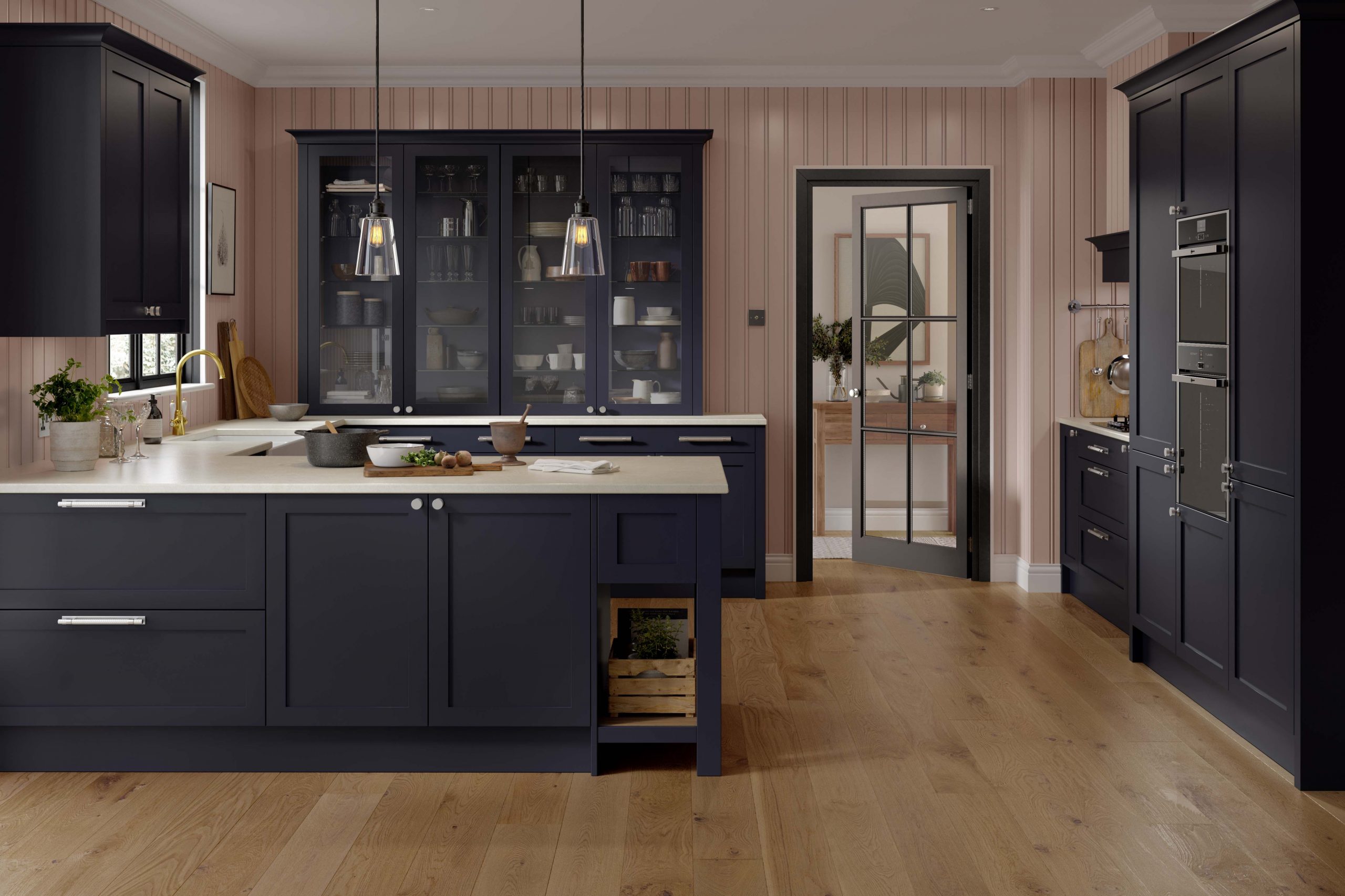
What makes a Shaker kitchen a luxury Shaker kitchen
A luxury Shaker kitchen is defined by four things: in-frame construction, where every door and drawer sits flush inside a solid timber frame; solid hardwood doors rather than MDF or foil wrap; a hand-applied paint finish in a bespoke colour; and cabinetry built to your exact millimetre, not assembled from standard carcass widths. Everything else, the worktop, the hardware, the appliances, follows from those four decisions.
It is the same visual language the Shakers used in the 18th century: a flat centre panel, a simple square-edged frame, no ornament. What separates a luxury Shaker kitchen from a mass-market one is not decoration. It is tolerance, timber, and finish.
Six details you will only find in a luxury kitchen
These are the specifications we hold to on every Shaker project. They are also the ones most often quietly dropped elsewhere to hit a price.
True in-frame construction
Doors and drawer fronts sit inside the cabinet frame with a consistent 3mm shadow gap all the way round. It is slower to build and far less forgiving of error, which is precisely why it reads as expensive.
Solid timber doors
Tulipwood, oak or ash, with a full-depth centre panel and mortise and tenon joints. Solid timber takes paint properly, holds a crisp arris, and can be repainted in fifteen years rather than replaced.
Hand-finished paint
Sprayed, flatted back, and recoated so the surface is dead flat with no orange peel. We colour-match to Farrow & Ball, Little Greene or any RAL reference, so the kitchen answers to the rest of the house.
Dovetailed drawer boxes
Solid oak boxes with dovetail joints, running on soft-close Blum or Hettich motion. You feel the difference the first time you close one, and every day after that.
Built to your millimetre
Bespoke widths, scribed to uneven walls, with cornice, pilasters and plinths cut on site. No filler panels stuffing the gaps where the standard sizes ran out.
Considered interiors
Cutlery inserts, pan drawers with internal dividers, a proper larder with adjustable shelving and integrated lighting. The luxury of a kitchen is mostly experienced behind the doors.
In-frame or classic Shaker?
Both are genuinely Shaker. They are built entirely differently, they cost differently, and they age differently. Here is the honest comparison.
| In-frame Shaker | Classic Shaker | |
|---|---|---|
| Construction | Door sits inside a solid timber face frame, flush with the cabinet front. | Door sits on the front of the carcass, covering it entirely. |
| Look | Traditional, furniture-like, with visible frame and shadow gaps. Reads as joinery. | Cleaner and quieter, with continuous door faces and slim gaps. Reads as cabinetry. |
| Internal space | Slightly reduced. The face frame takes roughly 20mm from each opening. | Maximised. The full carcass width is usable. |
| Tolerance | Extremely tight. Every gap is visible, so the fit has to be exact. | More forgiving, though a good installer still holds it to the millimetre. |
| Best suited to | Period properties, Victorian and Edwardian houses, larger kitchens where the frame can breathe. | Contemporary homes, smaller footprints, and transitional schemes that lean modern. |
| Investment | Higher. More timber, more labour, more finishing. | Lower for the same footprint, without compromising on materials. |
In-frame Shaker
- Construction
- Door sits inside a solid timber face frame, flush with the cabinet front.
- Look
- Traditional and furniture-like, with visible frame and shadow gaps.
- Internal space
- Slightly reduced. The frame takes roughly 20mm from each opening.
- Best for
- Period properties and larger kitchens where the frame can breathe.
- Investment
- Higher. More timber, more labour, more finishing.
Lay-on Shaker
- Construction
- Door sits on the front of the carcass, covering it entirely.
- Look
- Cleaner and quieter, with continuous door faces and slim gaps.
- Internal space
- Maximised. The full carcass width stays usable.
- Best for
- Contemporary homes, smaller footprints, transitional schemes.
- Investment
- Lower for the same footprint, with no compromise on materials.
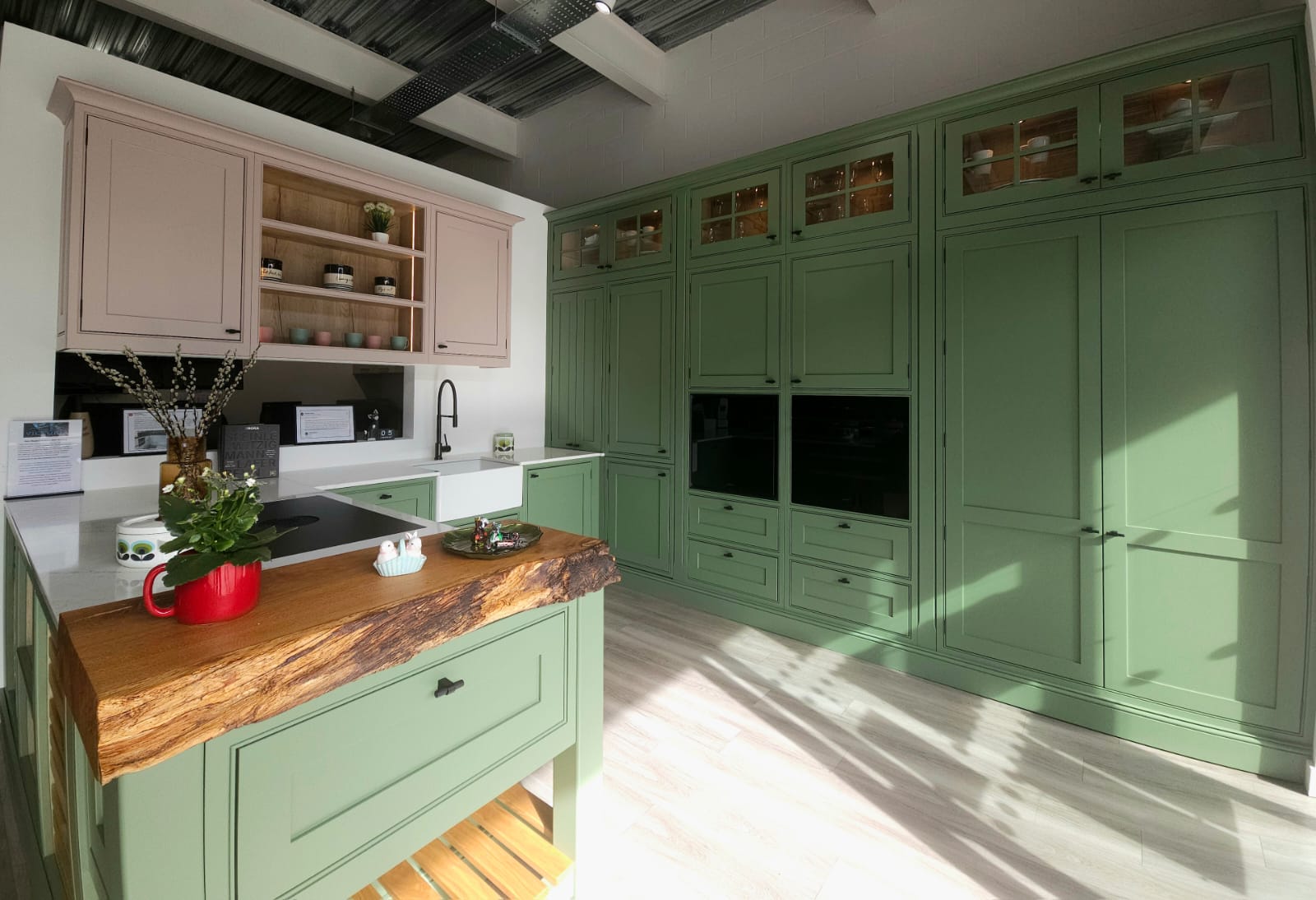
Made in Britain, engineered in Germany
Our Shaker cabinetry is manufactured in Britain by Caledonia, who build to order in solid timber with painted finishes applied by hand. It is the traditional route, and for an in-frame Shaker kitchen in a period London house, it is usually the right one.
Where a client wants Shaker aesthetics with German cabinet engineering and on a budget, we specify our own brand, VK: precision-machined carcasses, exceptional internal fittings, and a level of consistency that is very hard to argue with. Two routes, one standard.
- Solid tulipwood, oak and ash door programmes
- Bespoke colour matching to Farrow & Ball, Little Greene and RAL
- Blum and Hettich soft-close motion throughout
- Rigid-built carcasses, never flat-packed on site
- Cornice, pilasters and plinths scribed and fitted by our own installers
Three ways to wear a Shaker kitchen
Shaker is not one look. It is a construction method that can be pushed traditional, held in the middle, or pulled almost modern, depending on the house and the way you live in it.
Period, and unapologetic about it
In-frame cabinetry, a freestanding-look island, deep drawers, a range cooker in a chimney breast recess, and aged brass cup handles. Colours sit in the mineral end: stone, clay, deep green, off-black. This is the classic English kitchen, and it suits Victorian and Edwardian stock in Blackheath and Greenwich almost too well.
The one most clients land on
Shaker doors, but calmer: a slimmer frame, a single tone throughout, quartz or sintered stone rather than marble, and slim bar handles or integrated pulls. It reads traditional at a glance and contemporary on second look, which is exactly what most renovated London terraces want.
Shaker, stripped back
A narrow-frame lay-on Shaker in a flat, matt colour, paired with handleless tall units, a full-height larder wall and a waterfall island. All of the warmth of the timber, almost none of the period cues. Ideal for extensions and new-build side returns.
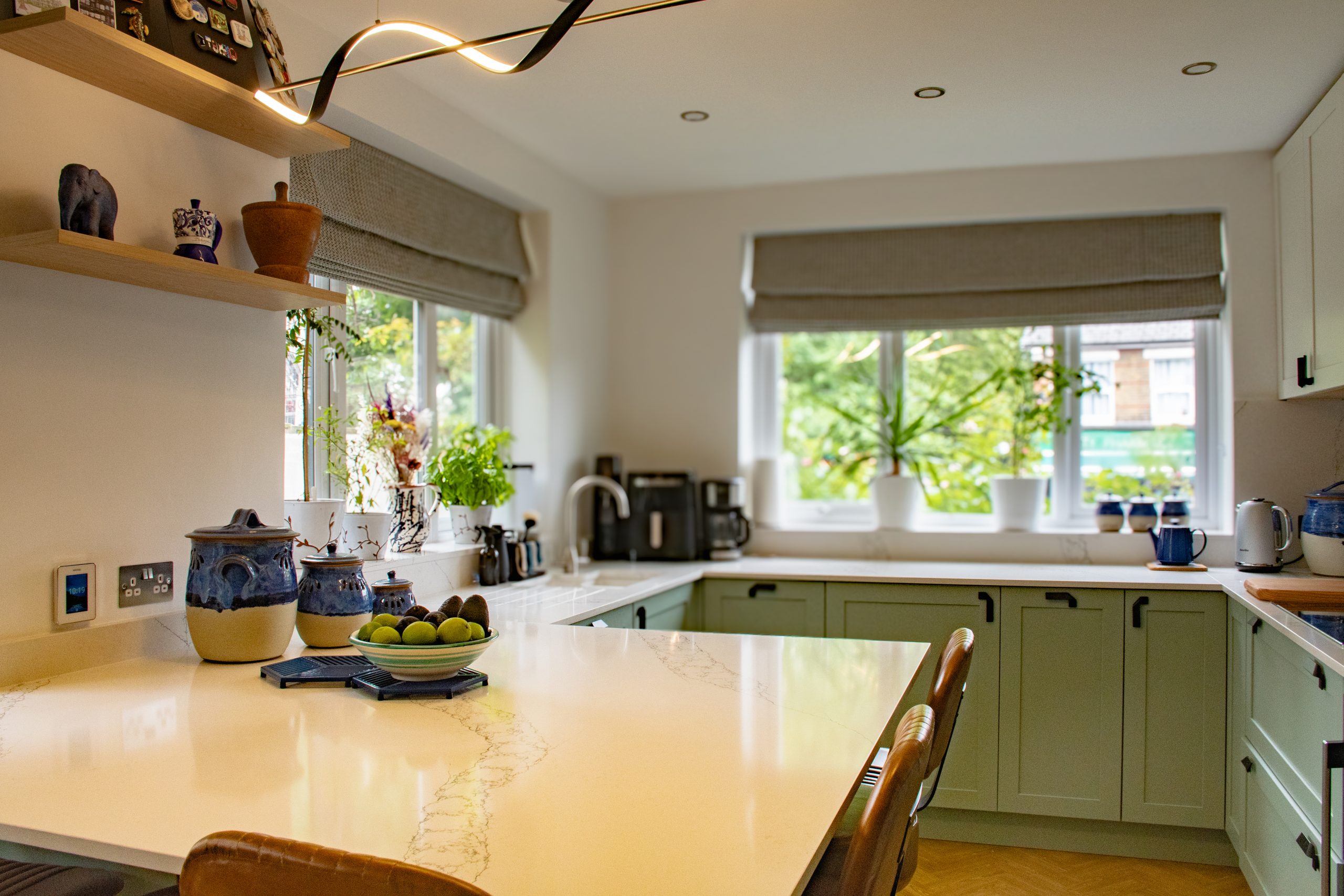
The worktop makes or breaks the kitchen
A Shaker kitchen has a lot of visual quiet in it. That means the worktop carries more weight than it would in a handleless scheme, and it is the one specification we ask clients to come into the showroom for. Photographs lie about stone.
- Marble, for the ones who want patina and will make peace with it.
- Quartz (Silestone, Quartzforms), for a marble look that survives a family.
- Sintered stone (Dekton), for heat, UV and scratch resistance, and for very thin profiles.
- Natural stone (Sensa), for the granite and quartzite end of the spectrum.
- Solid timber, usually as an island or a prep run rather than a full kitchen.
What a luxury Shaker kitchen actually costs
Nobody enjoys hunting for a price. These are honest ranges for a typical London kitchen, supplied and installed, excluding appliances and building works. Your design will land where it lands, and we will tell you before you commit to anything.
- Painted Shaker doors, rigid carcasses
- Quartz or laminate worktop
- Soft-close motion throughout
- Full design, supply and installation
- Solid timber in-frame cabinetry
- Hand-painted bespoke colour
- Dovetailed oak drawer boxes
- Quartz or sintered stone worktop
- Island, larder and bespoke joinery
From first sketch to final handle
One studio, one team, start to finish. The designer who drew your kitchen is the one who signs it off on site.
Showroom visit
An hour with a designer, no obligation. Bring plans, photos, and every opinion you have.
Survey
We measure your space ourselves. Every scribe and service gets recorded.
Design
Full 3D visuals and a fixed, itemised quotation. Revised until it is right.
Manufacture
Built to order in Britain or Germany, typically eight to twelve weeks.
Installation
Fitted by our own installers, not subcontractors, then snagged and handed over.
Victoria kitchens offer a proper bespoke, personal and high quality service from start to finish. So wonderful to have an independent business like this in Charlton to deliver such a high quality finish. Every person has been a delight to work with too.Susie Goss, Charlton, London
Luxury Shaker kitchens across South East London
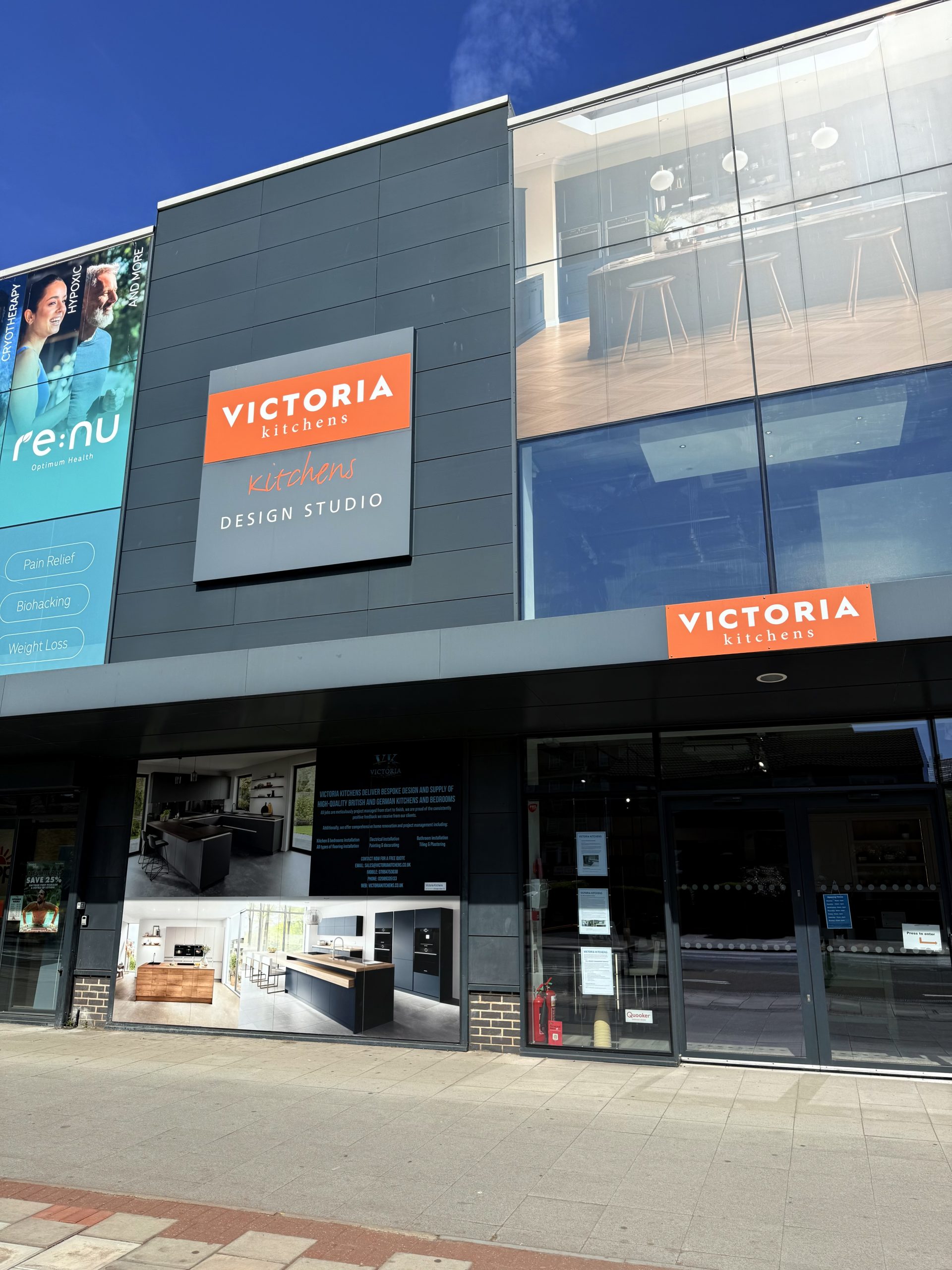
Our showroom sits at Charlton Riverside Centre on Woolwich Road, ten minutes from Greenwich and a short run from Blackheath, Eltham and Bexleyheath. We design and install throughout South East London and Kent, and we are happy to travel further for the right project.
Luxury Shaker kitchens, answered
What is a luxury Shaker kitchen?
A luxury Shaker kitchen is a bespoke kitchen built with in-frame or narrow-frame Shaker doors made from solid hardwood, finished with hand-applied paint, and manufactured to your exact dimensions rather than assembled from standard cabinet sizes. The defining features are solid timber construction, dovetailed drawer boxes, tight and consistent shadow gaps, and a paint finish that can be restored rather than replaced.
How much does a luxury Shaker kitchen cost in London?
As a guide, a classic Shaker kitchen starts around £18,000, a solid timber in-frame Shaker kitchen from roughly £25,000. Appliances and building works sit outside those figures. The two things that move the number most are the volume of cabinetry and the worktop material.
Is a Shaker kitchen still in style?
Shaker has been in continuous use for more than two centuries, which is a fairly strong argument that it is not a trend. It remains the most requested style in British kitchen design because it works in period and contemporary properties alike, takes any colour, and does not date the way high-gloss or heavily moulded doors do.
What is the difference between in-frame and classic Shaker?
In-frame doors sit inside a solid timber face frame, flush with the front of the cabinet, which creates the furniture-like look associated with traditional British kitchens. Classic doors sit on the front of the carcass and cover it completely, giving a cleaner and more contemporary face. In-frame costs more, uses more timber, and demands tighter tolerances. Lay-on gives you slightly more internal storage for the same footprint.
What timber are luxury Shaker doors made from?
Painted Shaker doors are most often made from tulipwood, which is stable, close-grained, and takes paint beautifully. Oak and ash are used where the timber is being stained or left natural. We avoid MDF and foil-wrapped doors on our Shaker programmes, because neither can be repainted properly once damaged.
Can you match my kitchen to a specific paint colour?
Yes. We colour-match to Farrow & Ball, Little Greene, RAL and NCS references, and we will produce a sample door in your chosen colour before anything goes into production. Seeing the colour on a real door, in your own light, is worth the extra week.
How long does a bespoke Shaker kitchen take?
Design and survey usually take two to four weeks depending on how many revisions you want. Manufacture is typically eight to twelve weeks. Installation runs one to three weeks depending on the size of the kitchen and whether building works are running alongside. Most clients are looking at three to five months from first showroom visit to handover.
Do you install the kitchen yourselves?
Yes. Our installers are part of the studio, not subcontracted in, and the designer who drew your kitchen is on site to sign it off. That matters more on an in-frame Shaker kitchen than on almost any other style, because every gap is visible and there is nowhere to hide a poor fit.
Where is your showroom?
Victoria Kitchens is at Charlton Riverside Centre, 375 Woolwich Road, London SE7. We are open Monday to Saturday, and we recommend booking so a designer is free to spend proper time with you. There is parking on site.